Wednesday, 8 June 2016

"I remain pale and interesting" a postcard from July 1987

Thirty years ago Fred and I were about to relocated to Paris with two babies and here I am planning a summer holiday in Europe. Of all the places to celebrate my 60th birthday it feels perfect to return to France.

Two friendships defined my time living in Marly-le-Roi, Sally and Andrea. It has become important for me to find these special women on my travels. I look at photos from these years and I so look forward to spending time with both of them. I want to sit around a table again with a glass of wine, to share memories and the bridge all the years. How wonderful, we are making it happen.

This postcard in my box of letters from Andrea makes me smile, I am not doubt she remains 'pale and interesting'. I am going to make a point of driving through the Haute Province, through the Gorge du Verdon neat Castillion, and to find fields of lavender and to take in the intoxicating fragrance.

Dearest Sally and Andrea, see you both soon!

Special friendships. France 1987

Wednesday, 20 April 2016

For my father: John Ennis Wedderburn

The vervet monkey on the laundry fence has balls that rival your blue eyes.
In this broken body, your eyes are beautiful, clear whites, no sign of the pterygiums that plagued you.
I recall the two operations and countless bottles of eye drops.
You have no need for your glasses either and I see those eyes clearly. Penetrating.
I am deep in tears when they stop seeing me.
Was there one more moment when you looked?
Did I feel your lips pucker lightly on my cheek?
I sit.
Your left foot moves with a light shudder now and again, the deformed nail visible, your toes deeply curled, but your foot is unblemished, smooth and fine boned.
Your left hand is perfect, the fingers long and straight with deep nail beds; your nails are to be admired.
Today we hold hands.

So many years of just patting your hand and only now do I hang onto this same hand?
You grip firmly. Reflex? I do not really care. It feels comforting for me.
Out the windows the sky echoes the blue I am looking at.
What colour are these curtains though, pink, orange, somewhere in between and they match that plant flourishing in the garden beyond the tar.
You have always been a quiet man and now you are silent.
They say the hearing remains as death nears, where are my words, they are failing me, and my vigil is in silence.
Beyond silence even, I am mute.
‘My Daddy”. Where does this longing come from, you have always been Dad.
Distracted.
A small black spider moves quickly along the basin, a fly has found its way into the room, this so called Angel Room with its broken pane of glass, even a midge or two catch my awareness.
I did not know that watching you being shaved by Freeman would be the last time, I could not begin to reason that this is your last day.
I lean forward and stroke your hand; I follow the deep valleys between the tendons and veins, strong, firm and graceful.
Your outline has been unchanged for a few years now, yoga tree pose, right leg tucked up high along the left leg, the rigidly bent right arm and clawed right hand all evidence of that long ago first stroke that did not take you from us, we had 17 more years with you.
I sit in gratitude.
I am tongue-tied during this day but my mind dances with thoughts.
 I watch the bubbles of regret that surface; I look at them, and match your breathing to come back to the present.
It exhausts me, you breathe deep from your belly, your chest straining and even the shoulder is engaged to do work.
What does it mean when they say you are not suffering.
Does the morphine make you oblivious to your red-faced coughing as you gasp for air?
I appreciate that some day the memories of this, your last day, will join all my other memories of you that span more than five decades.
But I cannot access memories right now, I am stuck in this day.
Gently rubbing your chest and shoulders I am in awe of your dignity.
How I respect you, my gentleman father and the legacy you leave me with.
Apart from saying that aging is not for sissies you have never complained.
You ask us to care for each other and you have been our role model on how to do that.
The Angel Room is not quiet.
The mattress vibrator clicks in and out of action, I can feel the rise and fall under my hand, the fan whirs trying to cool down this South Coast heat, staff come and go, the floor gets a lick of water, red-winged starlings are calling, the continual action of D-floor happens around us both.
The comings and goings have no interest to you, no more irritation or light frowning.
A cup of tea and a syrupy sweet mug of coffee for me are welcomed as the day lengthens.
I focus on the framed photos on the bedside table.
Our sisterhood reflects in our broad happy smiles, you had that same smile, you love us and we love you in turn.
Whole-heartedly.
Tears blur my vision when I watch your mouth, now a straining gaping hole, dry, a deep bubbling from the back of your throat as the flem builds and attempts to drown you. 
I am picking up an new odour.
Heart, keep beating please.
But, I want it to gave up gracefully, I do not want you to be on your own.
A damp, cool towel works its little bit of magic. As I gently wipe your face your brows lift in response, Dad you are here with me still.
You are gaunt, with eyes deeply sunken, what regal cheekbones, I run my hand over your sunken cheeks.
You loved food and today you can no longer eat or drink. 
I come empty handed.
My arm has gone numb, I slowly remove my hand, you shake in response, I text some updates to my sisters who wait in the same pain as me for the answer to the question ‘when?’
I am so tired and wait for the 6pm morphine, that 1ml syringed into the back of your throat.
The call comes later that night.
Hello Mooi Havens?
My physical body response is violent, the arrogance of thinking I would be prepared for the message from the empathetic voice on the phone.
Make the calls, find clothes, a late night drive, dark buildings, security guards, sliding door, a corridor.
I notice that I still respect your privacy under the worn, thin white sheet.
I take a deep breath, try to still my heart, and ease down the sheet from over your face.
A pillow necklaces your chin, your mouth no longer strains with each breath, it is so firmly shut now, as are your eyes.
I kiss you goodbye. And again.
The last time I hold your hand it is so soft, cooling, malleable, broken hearted I revert to patting your hand as I wait for your last bed to arrive.
I sit, I am so proud to be one of your girls; you are my ever-loving father.

John Ennis Wedderburn

22 June 1929 – 18 April 2016

Monday, 15 February 2016

A cousin finds me, power of the internet!

I had a surprise email recently, from Korea and from a Rudolph Van der Veen!

Rudolph is my first cousin. Mom's younger brother, Selwyn and Cora have 3 children, Andre, Rudolph and Emily.

Inel found these photos of a family champagne breakfast dated October 1991, 25 years ago now, when Selwyn and Cora visited Mom. Mom was battling her lymphoma, thin but has a lovely smile and seems happy to be reunited with her brother.

It is time to establish contact and connect with Mom's family.


Wednesday, 2 December 2015

Van der Veen story telling: Life ends for Dutch settler Arend Johannes in a shocking way

My jaw dropped when I was reading one of the emails I received from Alta Bekker with research information on Arend Johannes van der Veen, the Dutch settler to South Africa.

Manslaughter.
Hard drinking.
Suicide.

He had made the hugely challenging move from Europe to Port Natal, and then onto the Transvaal. He brought his children with him and they in turn settled, were builders and farmers, the family grew.

The building firm; Van der Veen, AJ & Zonen, were involved in the building of Church Square.

Here are some of the insights Alta sent me:

According to REX-03 p 136 in 1862 they started with the restoration and repairs to the old pastoral homestead.
The home was originally built for president [then still commandant-general] Pretorius but he never lived in it. 
It became the parish of the Chruch Square church and it was of the 1st home on the square and minister Begeman moved in at the end of 1862 or early 1863. 
Before he moved in renovations were done by the building contractors A.J. van der Veen en Zonen.

In 1872 Arend is convicted of manslaughter (Misdaad van doodslag): 
DEN DOOD VAN F DE  LILLE RADIER TEN GEVOLGE EENER VERWONDING AAN HET HOOFD HEM TOEGEBRAGT DOOR DEN CIPIER (Jailer in English) VAN HET GEVANGENHUIS TE PRETORIA op 26/3/1872 (SPR122-01 and -02; SPR199).

So I went looking for the references mentioned above,  two SPR documents at the National Archives. Letters from 1872 and in Dutch!

I am waiting for these letter to be translated.
And then sadly and finally, a decade later:

“DETERMINED SUICIDE – Last Thursday morning (23 Feb 1882) it was discovered that old Mr AJ van der Veen, an old resident of Pretoria, formerly gaoler here, had committed suicide. 
From an enquiry instituted by the authorities, it appeared that he was missed from his residence on Wednesday (22 Feb 1882) evening. 
Search was made by his relatives and late in the night his body was found in the small guard-house to the left of the Poort, with his throat-cut. 
On examination an old and very blunt razor was found near the body, his walking-stick was standing alongside the wall, his coat and necktie had been taken off and his shirt front was unbuttoned. Life must have been extinct for some time when the body was found. 
The deceased was about 73 years of age and is reported as having been a hard drinker lately. It appears that he had made an attempt on his life on Tuesday (21 Feb 1882) evening, but this was considered as only a drunken freak.”

Post script:
‘De Volkstem’/’Die Volkstem’ was a Dutch and Afrikaans newspaper that started to circulate in Pretoria in August of 1873, whereafter it was temporarily unpublished during the Second War of Liberation. Publications in the English language only emerged after 1880, but these did not endure very long. ‘De Volkstem’ continued its media life after the war in Pretoria until 1949, but then moved its audience to Johannesburg for a brief period, only to end its existence in 1950 for good.

Sunday, 29 November 2015

Van der Veen story telling: How about finding hidden treasure?

Hidden treasure indeed, linking 'my' Arend to this van der Veen clan in Pretoria
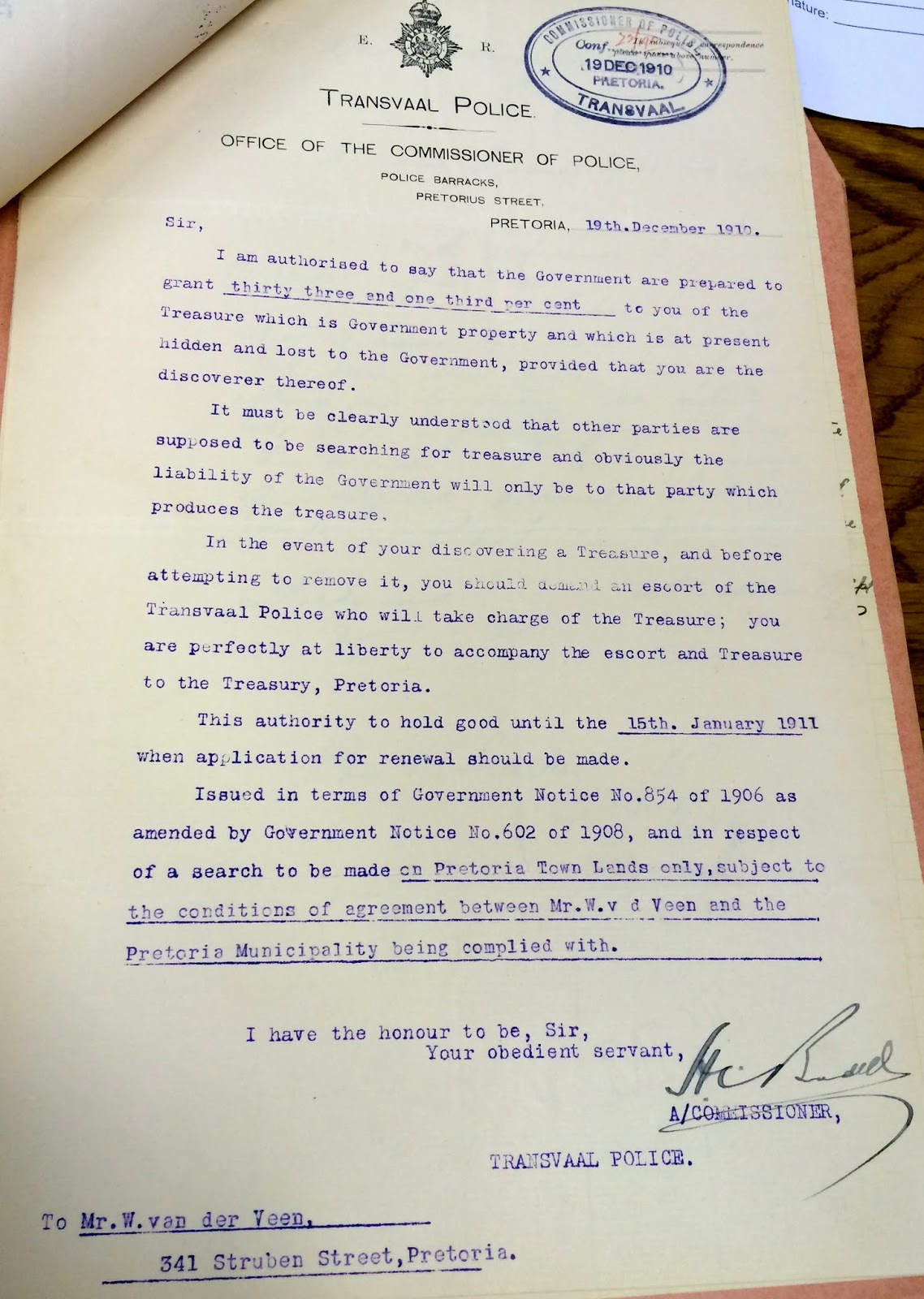
The date is December 1910, post the Boer Wars in Pretoria and citizens apply for permits to search for treasure on Pretoria Town Lands.

I loved retrieving this file from the National Archives in Pretoria, a slim folder, 115 years old, the cover has a James Bond feel to it - Secret Documents, signed by the Commissioner of the Transvaal Police in Pretoria.

The letter is an authorisation to one W. van der Veen granting him 33 and 1/3% of any treasure that he finds 'which is at present hidden and lost to the Government'. I can only assume that the treasure is military of nature.

This permit given is to Willem, the son of Arend Johannes van der Veen and he came out from Holland with his father, brother Hendrik Jan and sister Geertjen in 1858.

This document is a treasure to me for a very different reason, I may never be able to draw an accurate family tree but the document confirms the link between my van der Veen line and these Dutch settlers. The link comes from an unexpected place, an address on a Marriage Register from 1909, a year before the Hidden Treasure letters.

The address is 341 Struben Street, Pretoria. This is the same address given for Mr W. van der Veen on the letter from the Police Commissioner and for Sara Anna van der Veen at the time of her marriage to William Victor Sime.

Sara Anna is my mother's Great Aunt Annie.

Great Aunt Annie's Marriage Register from 1909. Note the address!

Van der Veen story telling: I would like compensation for my oxen and wagon

One of the assumptions I had made was that my grandfather William Hendry van der Veen was Afrikaans and after his marriage to Nellie, who as born on the Isle of Wight, the family becomes English speaking.

Looking at all the archive documents this does not seem to be the case, as many of the van der Veen clan marry into English speaking families, so English and Dutch are closely interwoven from the early days after settling in Pretoria.

I particularly enjoyed reading the Military Compensation Board documents that I sourced at the National Archives. From these documents I noticed that the van der Veen's also change their status during the Boer Wars, from Boer Commando's to either taking the Oath of Neutrality or the Oath of Allegiance to the British.

One written statement by Arend Johannes van der Veen (b 1859 - d 1932) in 1901, post the Second Boer War, is a delight to read and so full of detail.

He notes being born in Holland and that he came to the Transvaal in 1868, at 9 years old, I assume with his father Bernadus Johannes. This must have been the second wave of van der Veen arrivals, as the original Dutch Settler, AJ van der Veen came out with only 3 of his children in 1858.

After serving with the Pretoria District Commando, Arend Johannes takes the Oath of Neutrality in June 1900 and in his statement says he is willing to take the Oath of Allegiance. His written English is excellent and he makes it clear that he has not helped the Boers since his surrender either.

But, he is not happy with his ten oxen that were taken during the war, as well as his wagon that was commandeered and makes claim for reparation for these losses as well as damages to his house.

The file has written witness statements including that of his brother-in-law and business partner, Tom Austin, who is a British subject.

Even the farm staff were asked for their testament, here is part of a page where Abraham tells of a number of Boer soldiers that passed by the farm Garsfonetin and took 21 trek oxen.

Another random link, the Boer General was Hamilton, Arend Johannes refers to him in his documentation about the theft of his cattle, and the National Archives are in Hamilton Street in Pretoria....


Saturday, 28 November 2015

Van der Veen story telling: Family during the siege of Pretoria 1880-1881

Fred read me this quote from a Bloomberg article about the UAE. I marvel at how this bug on understanding my ancestral past has hooked me, whether the Wedderburn 1820 story, or my Nan's story from the Isle of Wight and now the van der Veen story, Dutch settlers who landed in Port Natal and then made their way to Pretoria only to get embroiled in war. The late eighteen hundred's early nineteen hundred's were not easy years in the Transvaal, the years of the First and Second Boer Wars.

My traveling to and from the National Archives has given me time in the Pretoria CBD, so it was with some astonishment that I found this photo online, Pretoria in 1880, and taken from the home of Mr van der Veen. Amazing, this would have been the home of one of the sons of the Dutch settler, Arend Johannes. I have analysed all the addresses where the van der Veen's lived over the last century and looking at the angle of the photo relative to the map below it could have been taken from Struben Street where a lot of the family lived.
A photo I found on the internet, caption says
"Convent Redoubt and Jail Laager from Mr van der Veen's house"


The view from the van der Veen home would have been looking south towards the Convent (17)
with the Fort Commeline  (5) which is just opposite the Voortrekker Monument.
Wonderful old register logging the photos taken for the Pretoria News including photo 34237.
I followed a lead on another photograph, sourced the huge old register from the National Archives and found the reference detail. The reference  confirms that Mr AJ van der Veen, the grandson of the original Dutch Settler, was one of the Pretoria citizens who were laagered into the Convent Redoubt by the British during the First Anglo Boer War in 1880.

He also served in the Second Anglo Boer War. The reference on the photo mentions that he was the Foreman of the Bricklayers when the Church on Church Square was built. The family profession of builders and bricklayers reaches it's peak during this time.

I have not been able to map my great grandfather, Arend Johannes van der Veen, to this particular AJ, my premise is that we are descendant from another of the brothers who came out with their father, the original AJ van der Veen...

The research continues.
Mr Arent Johannes van der Veen, grandson of the original Dutch settler,
son of Bernadus Johannes van der Veen.