Tuesday, 27 December 2016

A Wedderburn letter on Facebook!

There is an 1820 Settler's Group on Facebook and I briefly note their posts until this one popped into my inbox. So exciting! 
A letter to my ancestor William Wedderburn, the son of Christopher and Ann (nee Quail), from his cousin John Wedderburn from  Manchester. William and his brother George, who is mentioned in the letter came out with their parents in 1820, William settled in Grahamstown and George farmed with Christopher at Linsdale in Salem. I so not have a photo of this William Wedderburn.

From 1820 Settler Facebook post: by Warren G Mandy on the 16 November 2016. 
By Peter Garwood in France
Dear Cousin! 
[WILLIAM WEDDERBURN b. 1800, grandfather of Alexander John Ennis, centre of photo]
Back Row: Percy (my grandfather), Lex, (Alexander, who was killed in the First World War), Daisy, Barry, Boetie

Centre Row: Gwen, Frances Alice (Birdie), Alexander John Ennis, Susannah Alice (Cawood), Polly

Front Row: Stella, Phyllis (daughter of Daisy & AH Holmes), Prim and Joyce.

PHOTO TAKEN 1903/1904
I received your letter of the 20th February and likewise one from your brother George of the 5th. Feb. 
I have not seen or heard anything of Mr. Shaw since I received the letter, he sent it by Post. I am glad to hear that you are all recovered from your late sickness. 
I am sorry to inform you that my eldest sister Mary Ann is dead, she died in child bed, she has left two children, Sister Betsy has 3, and Sister Jane is now lying in of the 4th, I believe she is doing well, she lives at Eccles, Brother Adam lives with me, he is single yet; I think I sent you word in my last, that Uncle William was dead; there is a cousin of ours by the name of Bibbey, that lives here in Manchester, he is a Sailor, I believe the rest of relations at Ulverston are all well; it appears that you hear bad accounts of England, but it is without foundation; Trade has been very brisk in general, you would scarce know Manchester, they have made a deal of the public streets, wider such as Market Street, and many others, there are large public Buildings making all over the Town, there seems no be no want of money amongst them, there is a Railway to Liverpool, we can go 36 miles in 1½ hours; 

I sent your letter to Mr. Quail of Liverpool, he was glad to hear from you, they are all very well, they have not received a letter from you these 2 or 3 years, they thought you were all dead. I understood they had written frequently to you; they have made Manchester into a Borough Town, we send 2 Members to Parliament; we are going to have the ******* held here instead of Lancaster, they say we are to be governed by a Mayor; my wife’s Brother and family are gone to America, my wife wants to go, but I think there is no place like Old England. Times were never much better, tho’ we are heavy taxed, they are going to reduce many of them, and I don’t mind, how soon. 
Mr. Adamthwait is very well, he is always glad to hear from you, he is retired from Business, and given it up to his son, I do business with them, and have done some years, he wishes to be kindly remembered to Uncle & Aunt, Mrs. Boden is very well, sends her respects and Mother’s to all, and could like to see Uncle & Aunt, if it was not so far, there are many always enquiring after my Uncle, Mr. Bewley ***** belonging to the Sick Society that he belonged, Mr. Shaw that was the Clerk of it, belongs to a Society that I am in, there is a Mr. Milner attends my house regular, that is often talking about him, and Mr. Pod that died, had your house, he was apprentice with Mr. Brown **** Deans Gate; Mrs Russell’s printing Concern is given ****, the Sons are turned out wild, one is a Doctor, the youngest Samuel should have looked after the Business, but he was too fond of his Drink. 
Mr. Fawcet still lives in the old place, Mr. Lane & family are still living and doing well, Mr. Lane has been presented with a piece of Plate for his long service in the Philanthropic Society; we have 5 or 6 new Churches built in Manchester, and the neighbourhood, besides many Chapels since you left, indeed it is not like the same place, there are finer shops in Market Street, than there are in London, they are built of Stone *** 6 stories high. 
Give my Wife’s very kindest respects to my Uncle & Aunt, your cousin George & Sisters, tell him I received his letter, and was glad to hear they were so comfortable at home, I would like to see my Uncle and all of you once more, but that is impossible, so I remain
Your affectionate Cousin,
John Wedderburn
Tell your Brother to direct for me at the Adam * Collingwood Fleetstreet, Deansgate, it is the house that I keep at present.

Tuesday, 16 August 2016

Finding Chartree Villa in Freshwater, Isle of Wight

Ventnor Old Cemetery floating above the Atlantic Ocean
Records from the Heritage Museum in Ventnor showed that Ann Argyle, my great, great grandmother, died on the 14 December in 1894 and was buried in the Old Cemetery in Ventnor in Plot B, 2869. Fred and I walked around the cemetery but the headstones are so faded and the plots unmarked, so we quietly moved on. She had died before meeting her little granddaughter, Nellie.

William and Kathleen were living at No 2, Chartree Villa, Copse Lane in Freshwater when Nan was born in 1899. We headed to Freshwater, found Copse Lane and were so surprised to find the house, still called Chartree almost 120 years later! I felt emotional and teary, Nan meant so much to me as a little girl living in Vanderbijlpark.

Nan's Birth Certificate noting the family's address in Freshwater as Chartree Villa, Copse Lane
William and Kathleen's home on Copse Lane and the views of the streets where they would have walked.

Postscript:

I am going to dedicate my latest quilt that I am working on to Ann Argyle as a celebration of my female line. 

The quilt is inspired from a workshop with Kaffe Fassett and I used pieces of Mom's material and antique fabric in the quilt. 

Maybe the title could be: Hands over the Ages.

Life of a Laundress in Ventnor, Isle of Wight


Walking to the Heritage Museum in Ventnor, I could not believe that their display and focus was on the Laundresses of Ventnor in the 1880's! It felt as if the universe was talking to me, if not my great, great grandmother Ann. 

After leaving service at London House she was a Charwoman and then in the 1871 and 1881 Census's she is a Laundress. Reading the information at the Museum, they even mention the street where she lived with John and her children William (my great grandfather) and Anne - St. Catherine's Street. So moving.

It is not clear whether she worked for the 'modern' steam laundry or whether she took in laundry but either way, she laboured long and hard over the decades in this Victorian era town, that was popular with consumptives from the mainland. The arch in the photo above was the entrance to the laundry.

The 1871 Census, Ann is a mother now, with 2 children and a laundress in Ventnor.
The Argyle home at 54 St. Catherine's Street, is now number 14, another amazing bit of sleuthing done by Jeff from the Ventnor History Society. Fred and I walked the town understanding Ann's neighbourhood and took photos of her street and home. 
Just remarkable that so much survives for which I am so grateful.

Finding the home of my great, great grandmother Ann Argyle during 19th until her death in 1894.
Information from the Ventnor Heritage Museum:


The story of a Housemaid a London House, Ventnor, Isle of Wight

Finding London House in Ventnor where my great, great Grandmother was a Housemaid
I have come to the Isle of Wight and to Ventnor specifically to find traces of my mother's maternal line. My Nan, Nellie Winifred van der Veen, (nee Argyle), was born here. 

During my ancestral research Ann Sibbick's story completely captured my imagination. After growing up in Ryde, the 1851 Census shows her in service as a Housemaid at London House, Ventnor, working for a Elizabeth Briant a Wine Merchant.

Ann, goes onto marry John Argyle and she is my great, great grandmother.

1851 Census, a 20 year old Ann Sibbick is a Housemaid at London House.
Fred and I went into the Heritage Society in Ventnor and met Jeff, I shared the story with him and asked for help in tracing London House. He was fabulous, he spent the day researching all the historical documents, followed a few leads and worked out the story of London House!

It was right under our nose, a building in High Street, Ventnor developed by Elizabeth Briant's father-in-law, that you can see from the Society's office! The deli called The Kitchen@London House is at the centre of the building. We popped into the deli and met the owner who used the name London House because the previous owner had used it in their address too. The dentist offices next door have retained the original sweeping staircase. I was so thrilled!

So thrilled to find London House, chatting to the Deli owner about the history and going up the original stairs, now a dentist's rooms.
High Street, Ventnor in 1880's

The story of a Housemaid a London House, Ventnor, Isle of Wight

Finding London House in Ventnor where my great, great Grandmother was a Housemaid
I have come to the Isle of Wight and to Ventnor specifically to find traces of my mother's maternal line. My Nan, Nellie Winifred van der Veen, (nee Argyle), was born here. 

During my ancestral research Ann Sibbick's story completely captured my imagination. After growing up in Ryde, the 1851 Census shows her in service as a Housemaid at London House, Ventnor, working for a Elizabeth Briant a Wine Merchant.

Ann, goes onto marry John Argyle and she is my great, great grandmother.

1851 Census, a 20 year old Ann Sibbick is a Housemaid at London House.
Fred and I went into the History Society in Ventnor and met Jeff, I shared the story with him and asked for help in tracing London House. He was fabulous, he spent the day researching all the historical documents, followed a few leads and worked out the story of London House!

It was right under our nose, a building in High Street, Ventnor developed by Elizabeth Briant's father-in-law, that you can see from the Society's office! The deli called The Kitchen@London House is at the centre of the building. We popped into the deli and met the owner who used the name London House because the previous owner had used it in their address too. The dentist offices next door have retained the original sweeping staircase. I was so thrilled!

So thrilled to find London House, chatting to the Deli owner about the history and going up the original stairs, now a dentist's rooms.
High Street, Ventnor in 1880's

Wednesday, 8 June 2016

"I remain pale and interesting" a postcard from July 1987

Thirty years ago Fred and I were about to relocated to Paris with two babies and here I am planning a summer holiday in Europe. Of all the places to celebrate my 60th birthday it feels perfect to return to France.

Two friendships defined my time living in Marly-le-Roi, Sally and Andrea. It has become important for me to find these special women on my travels. I look at photos from these years and I so look forward to spending time with both of them. I want to sit around a table again with a glass of wine, to share memories and the bridge all the years. How wonderful, we are making it happen.

This postcard in my box of letters from Andrea makes me smile, I am not doubt she remains 'pale and interesting'. I am going to make a point of driving through the Haute Province, through the Gorge du Verdon neat Castillion, and to find fields of lavender and to take in the intoxicating fragrance.

Dearest Sally and Andrea, see you both soon!

Special friendships. France 1987

Wednesday, 20 April 2016

For my father: John Ennis Wedderburn

The vervet monkey on the laundry fence has balls that rival your blue eyes.
In this broken body, your eyes are beautiful, clear whites, no sign of the pterygiums that plagued you.
I recall the two operations and countless bottles of eye drops.
You have no need for your glasses either and I see those eyes clearly. Penetrating.
I am deep in tears when they stop seeing me.
Was there one more moment when you looked?
Did I feel your lips pucker lightly on my cheek?
I sit.
Your left foot moves with a light shudder now and again, the deformed nail visible, your toes deeply curled, but your foot is unblemished, smooth and fine boned.
Your left hand is perfect, the fingers long and straight with deep nail beds; your nails are to be admired.
Today we hold hands.

So many years of just patting your hand and only now do I hang onto this same hand?
You grip firmly. Reflex? I do not really care. It feels comforting for me.
Out the windows the sky echoes the blue I am looking at.
What colour are these curtains though, pink, orange, somewhere in between and they match that plant flourishing in the garden beyond the tar.
You have always been a quiet man and now you are silent.
They say the hearing remains as death nears, where are my words, they are failing me, and my vigil is in silence.
Beyond silence even, I am mute.
‘My Daddy”. Where does this longing come from, you have always been Dad.
Distracted.
A small black spider moves quickly along the basin, a fly has found its way into the room, this so called Angel Room with its broken pane of glass, even a midge or two catch my awareness.
I did not know that watching you being shaved by Freeman would be the last time, I could not begin to reason that this is your last day.
I lean forward and stroke your hand; I follow the deep valleys between the tendons and veins, strong, firm and graceful.
Your outline has been unchanged for a few years now, yoga tree pose, right leg tucked up high along the left leg, the rigidly bent right arm and clawed right hand all evidence of that long ago first stroke that did not take you from us, we had 17 more years with you.
I sit in gratitude.
I am tongue-tied during this day but my mind dances with thoughts.
 I watch the bubbles of regret that surface; I look at them, and match your breathing to come back to the present.
It exhausts me, you breathe deep from your belly, your chest straining and even the shoulder is engaged to do work.
What does it mean when they say you are not suffering.
Does the morphine make you oblivious to your red-faced coughing as you gasp for air?
I appreciate that some day the memories of this, your last day, will join all my other memories of you that span more than five decades.
But I cannot access memories right now, I am stuck in this day.
Gently rubbing your chest and shoulders I am in awe of your dignity.
How I respect you, my gentleman father and the legacy you leave me with.
Apart from saying that aging is not for sissies you have never complained.
You ask us to care for each other and you have been our role model on how to do that.
The Angel Room is not quiet.
The mattress vibrator clicks in and out of action, I can feel the rise and fall under my hand, the fan whirs trying to cool down this South Coast heat, staff come and go, the floor gets a lick of water, red-winged starlings are calling, the continual action of D-floor happens around us both.
The comings and goings have no interest to you, no more irritation or light frowning.
A cup of tea and a syrupy sweet mug of coffee for me are welcomed as the day lengthens.
I focus on the framed photos on the bedside table.
Our sisterhood reflects in our broad happy smiles, you had that same smile, you love us and we love you in turn.
Whole-heartedly.
Tears blur my vision when I watch your mouth, now a straining gaping hole, dry, a deep bubbling from the back of your throat as the flem builds and attempts to drown you. 
I am picking up an new odour.
Heart, keep beating please.
But, I want it to gave up gracefully, I do not want you to be on your own.
A damp, cool towel works its little bit of magic. As I gently wipe your face your brows lift in response, Dad you are here with me still.
You are gaunt, with eyes deeply sunken, what regal cheekbones, I run my hand over your sunken cheeks.
You loved food and today you can no longer eat or drink. 
I come empty handed.
My arm has gone numb, I slowly remove my hand, you shake in response, I text some updates to my sisters who wait in the same pain as me for the answer to the question ‘when?’
I am so tired and wait for the 6pm morphine, that 1ml syringed into the back of your throat.
The call comes later that night.
Hello Mooi Havens?
My physical body response is violent, the arrogance of thinking I would be prepared for the message from the empathetic voice on the phone.
Make the calls, find clothes, a late night drive, dark buildings, security guards, sliding door, a corridor.
I notice that I still respect your privacy under the worn, thin white sheet.
I take a deep breath, try to still my heart, and ease down the sheet from over your face.
A pillow necklaces your chin, your mouth no longer strains with each breath, it is so firmly shut now, as are your eyes.
I kiss you goodbye. And again.
The last time I hold your hand it is so soft, cooling, malleable, broken hearted I revert to patting your hand as I wait for your last bed to arrive.
I sit, I am so proud to be one of your girls; you are my ever-loving father.

John Ennis Wedderburn

22 June 1929 – 18 April 2016

Monday, 15 February 2016

A cousin finds me, power of the internet!

I had a surprise email recently, from Korea and from a Rudolph Van der Veen!

Rudolph is my first cousin. Mom's younger brother, Selwyn and Cora have 3 children, Andre, Rudolph and Emily.

Inel found these photos of a family champagne breakfast dated October 1991, 25 years ago now, when Selwyn and Cora visited Mom. Mom was battling her lymphoma, thin but has a lovely smile and seems happy to be reunited with her brother.

It is time to establish contact and connect with Mom's family.


Wednesday, 2 December 2015

Van der Veen story telling: Life ends for Dutch settler Arend Johannes in a shocking way

My jaw dropped when I was reading one of the emails I received from Alta Bekker with research information on Arend Johannes van der Veen, the Dutch settler to South Africa.

Manslaughter.
Hard drinking.
Suicide.

He had made the hugely challenging move from Europe to Port Natal, and then onto the Transvaal. He brought his children with him and they in turn settled, were builders and farmers, the family grew.

The building firm; Van der Veen, AJ & Zonen, were involved in the building of Church Square.

Here are some of the insights Alta sent me:

According to REX-03 p 136 in 1862 they started with the restoration and repairs to the old pastoral homestead.
The home was originally built for president [then still commandant-general] Pretorius but he never lived in it. 
It became the parish of the Chruch Square church and it was of the 1st home on the square and minister Begeman moved in at the end of 1862 or early 1863. 
Before he moved in renovations were done by the building contractors A.J. van der Veen en Zonen.

In 1872 Arend is convicted of manslaughter (Misdaad van doodslag): 
DEN DOOD VAN F DE  LILLE RADIER TEN GEVOLGE EENER VERWONDING AAN HET HOOFD HEM TOEGEBRAGT DOOR DEN CIPIER (Jailer in English) VAN HET GEVANGENHUIS TE PRETORIA op 26/3/1872 (SPR122-01 and -02; SPR199).

So I went looking for the references mentioned above,  two SPR documents at the National Archives. Letters from 1872 and in Dutch!

I am waiting for these letter to be translated.
And then sadly and finally, a decade later:

“DETERMINED SUICIDE – Last Thursday morning (23 Feb 1882) it was discovered that old Mr AJ van der Veen, an old resident of Pretoria, formerly gaoler here, had committed suicide. 
From an enquiry instituted by the authorities, it appeared that he was missed from his residence on Wednesday (22 Feb 1882) evening. 
Search was made by his relatives and late in the night his body was found in the small guard-house to the left of the Poort, with his throat-cut. 
On examination an old and very blunt razor was found near the body, his walking-stick was standing alongside the wall, his coat and necktie had been taken off and his shirt front was unbuttoned. Life must have been extinct for some time when the body was found. 
The deceased was about 73 years of age and is reported as having been a hard drinker lately. It appears that he had made an attempt on his life on Tuesday (21 Feb 1882) evening, but this was considered as only a drunken freak.”

Post script:
‘De Volkstem’/’Die Volkstem’ was a Dutch and Afrikaans newspaper that started to circulate in Pretoria in August of 1873, whereafter it was temporarily unpublished during the Second War of Liberation. Publications in the English language only emerged after 1880, but these did not endure very long. ‘De Volkstem’ continued its media life after the war in Pretoria until 1949, but then moved its audience to Johannesburg for a brief period, only to end its existence in 1950 for good.

Sunday, 29 November 2015

Van der Veen story telling: How about finding hidden treasure?

Hidden treasure indeed, linking 'my' Arend to this van der Veen clan in Pretoria
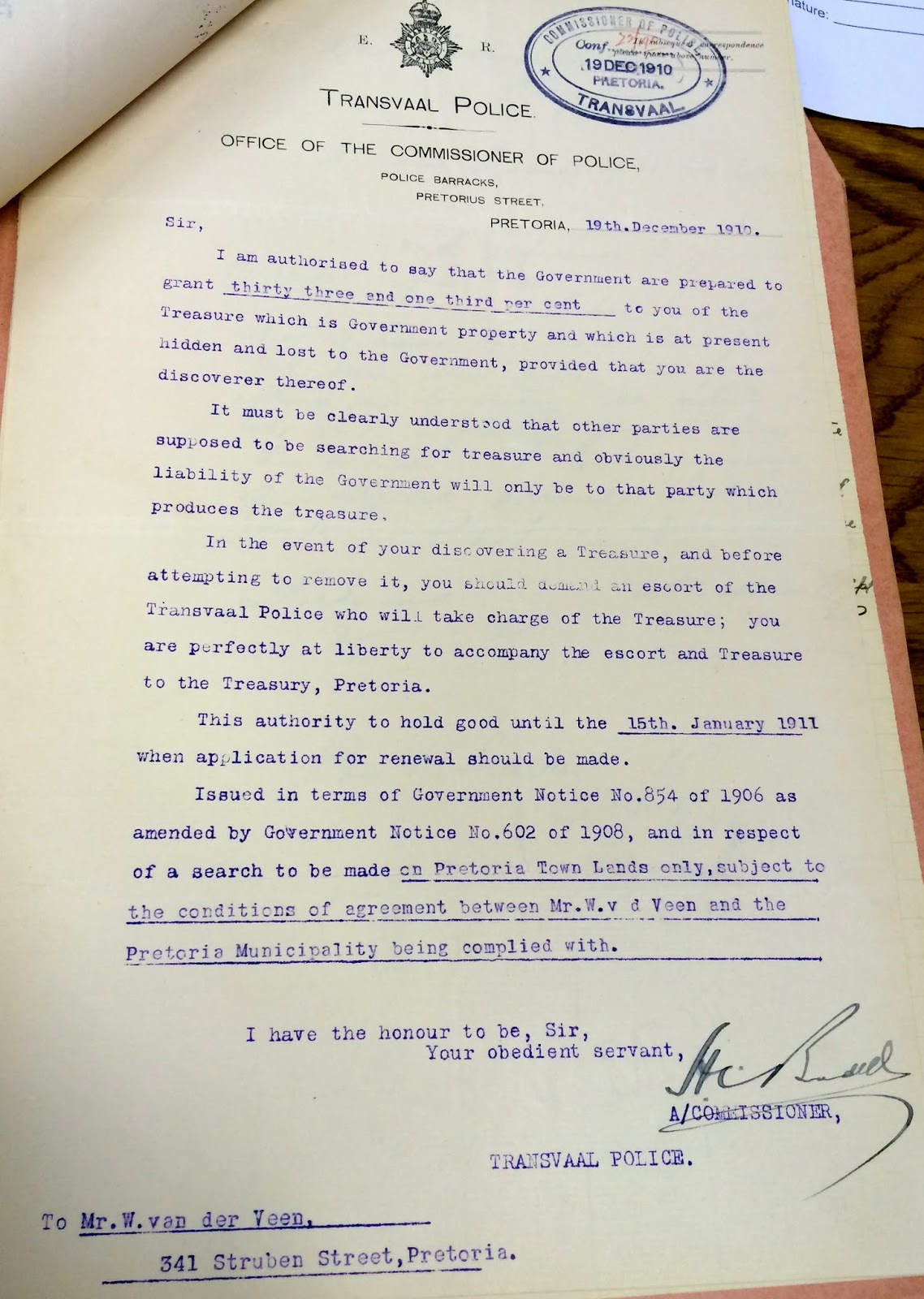
The date is December 1910, post the Boer Wars in Pretoria and citizens apply for permits to search for treasure on Pretoria Town Lands.

I loved retrieving this file from the National Archives in Pretoria, a slim folder, 115 years old, the cover has a James Bond feel to it - Secret Documents, signed by the Commissioner of the Transvaal Police in Pretoria.

The letter is an authorisation to one W. van der Veen granting him 33 and 1/3% of any treasure that he finds 'which is at present hidden and lost to the Government'. I can only assume that the treasure is military of nature.

This permit given is to Willem, the son of Arend Johannes van der Veen and he came out from Holland with his father, brother Hendrik Jan and sister Geertjen in 1858.

This document is a treasure to me for a very different reason, I may never be able to draw an accurate family tree but the document confirms the link between my van der Veen line and these Dutch settlers. The link comes from an unexpected place, an address on a Marriage Register from 1909, a year before the Hidden Treasure letters.

The address is 341 Struben Street, Pretoria. This is the same address given for Mr W. van der Veen on the letter from the Police Commissioner and for Sara Anna van der Veen at the time of her marriage to William Victor Sime.

Sara Anna is my mother's Great Aunt Annie.

Great Aunt Annie's Marriage Register from 1909. Note the address!

Van der Veen story telling: I would like compensation for my oxen and wagon

One of the assumptions I had made was that my grandfather William Hendry van der Veen was Afrikaans and after his marriage to Nellie, who as born on the Isle of Wight, the family becomes English speaking.

Looking at all the archive documents this does not seem to be the case, as many of the van der Veen clan marry into English speaking families, so English and Dutch are closely interwoven from the early days after settling in Pretoria.

I particularly enjoyed reading the Military Compensation Board documents that I sourced at the National Archives. From these documents I noticed that the van der Veen's also change their status during the Boer Wars, from Boer Commando's to either taking the Oath of Neutrality or the Oath of Allegiance to the British.

One written statement by Arend Johannes van der Veen (b 1859 - d 1932) in 1901, post the Second Boer War, is a delight to read and so full of detail.

He notes being born in Holland and that he came to the Transvaal in 1868, at 9 years old, I assume with his father Bernadus Johannes. This must have been the second wave of van der Veen arrivals, as the original Dutch Settler, AJ van der Veen came out with only 3 of his children in 1858.

After serving with the Pretoria District Commando, Arend Johannes takes the Oath of Neutrality in June 1900 and in his statement says he is willing to take the Oath of Allegiance. His written English is excellent and he makes it clear that he has not helped the Boers since his surrender either.

But, he is not happy with his ten oxen that were taken during the war, as well as his wagon that was commandeered and makes claim for reparation for these losses as well as damages to his house.

The file has written witness statements including that of his brother-in-law and business partner, Tom Austin, who is a British subject.

Even the farm staff were asked for their testament, here is part of a page where Abraham tells of a number of Boer soldiers that passed by the farm Garsfonetin and took 21 trek oxen.

Another random link, the Boer General was Hamilton, Arend Johannes refers to him in his documentation about the theft of his cattle, and the National Archives are in Hamilton Street in Pretoria....


Saturday, 28 November 2015

Van der Veen story telling: Family during the siege of Pretoria 1880-1881

Fred read me this quote from a Bloomberg article about the UAE. I marvel at how this bug on understanding my ancestral past has hooked me, whether the Wedderburn 1820 story, or my Nan's story from the Isle of Wight and now the van der Veen story, Dutch settlers who landed in Port Natal and then made their way to Pretoria only to get embroiled in war. The late eighteen hundred's early nineteen hundred's were not easy years in the Transvaal, the years of the First and Second Boer Wars.

My traveling to and from the National Archives has given me time in the Pretoria CBD, so it was with some astonishment that I found this photo online, Pretoria in 1880, and taken from the home of Mr van der Veen. Amazing, this would have been the home of one of the sons of the Dutch settler, Arend Johannes. I have analysed all the addresses where the van der Veen's lived over the last century and looking at the angle of the photo relative to the map below it could have been taken from Struben Street where a lot of the family lived.
A photo I found on the internet, caption says
"Convent Redoubt and Jail Laager from Mr van der Veen's house"


The view from the van der Veen home would have been looking south towards the Convent (17)
with the Fort Commeline  (5) which is just opposite the Voortrekker Monument.
Wonderful old register logging the photos taken for the Pretoria News including photo 34237.
I followed a lead on another photograph, sourced the huge old register from the National Archives and found the reference detail. The reference  confirms that Mr AJ van der Veen, the grandson of the original Dutch Settler, was one of the Pretoria citizens who were laagered into the Convent Redoubt by the British during the First Anglo Boer War in 1880.

He also served in the Second Anglo Boer War. The reference on the photo mentions that he was the Foreman of the Bricklayers when the Church on Church Square was built. The family profession of builders and bricklayers reaches it's peak during this time.

I have not been able to map my great grandfather, Arend Johannes van der Veen, to this particular AJ, my premise is that we are descendant from another of the brothers who came out with their father, the original AJ van der Veen...

The research continues.
Mr Arent Johannes van der Veen, grandson of the original Dutch settler,
son of Bernadus Johannes van der Veen.

Friday, 27 November 2015

Van der Veen story telling: Arriving in South African from Holland

How I love the moment when something clicks into place, I had one of these moments recently while visiting a dear school friend, Benedikte. 

Her husband Peter showed me his glorious, hand-drawn and hand-painted map of the Colony of Natal dated 1893. The map hangs with pride in his bar at home and it was drawn by his ancestor Mr W. H. Nott, his great-uncle. Peter has a remarkable collection of memorabilia about this interesting man.

I immediately went looking up close at the map to see if I could find a place called New Gelderland, just north of Stanger. This Dutch settlement, according to the reading and research I had been doing, was established some 30 years before the map was drawn. 

And there it was - spelt, New Guelderland, close to Stanger, a little north-east and near the railway line. 

A section of the historic 1893 map drawn by W.H. Nott in the home of Peter Nott.
This name has real historical significance, it represented home to a small group of Dutch Settlers to South Africa who arrived between 1858 and 1860. And even more so, it is historically significant to me, on board the Estafette which reached Port Natal on the 26th August 1858 was a 'Mr and Mrs AJ van der Veen and 3 children', my mother's ancestors had arrived from Holland! She was Daphne Estelle van der Veen and I have been attempting to trace her fathers family.

Arend Johannes was born on the 14 January 1809 within the community of Brummen, a town near Arnhem in the Province of Gelderland. The Reformed Church records that his mother was Berendina van der Veen (born 1770) and that he was illegitimate. She had further illegitimate children and apparently this was not unusual in this era in Europe.

Arend Johannes born Brummen, Gelderland 14.1.1809 and baptised Brummen 9.4.1809.


I received this scanned image of the Reformed Church record from a fellow van der Veen researcher that I have made contact with. Alta Bekker has been invaluable in helping me piece together the van der Veen story here in South Africa. Alta, who is also related to this van der Veen family through Arend's daughter Barendina, provided me with the following about Arend's life in Holland before his sailing to South Africa.

Nothing further is known about Arend until his marriage to Janna Bierhof. Both lived in Brummen, and the marriage was confirmed in the town hall on the 10 Oct 1829 in the presence of witnesses. Arendt was a minor, aged 20, a bricklayers helper, and had not been required to undertake military training. Janna was 26, born in Brummen, the daughter of Harmen Bierhof and Geertruij Schoemaker, labourer and housewife respectively. At the time of the marriage, Janna was a maid-servant, and heavily pregnant.
Arend's second marriage to Catrina, our line.
Married Life:
Arendt and Janna had two children in Brummen, Maria and Geertje. Arend’s wife, Jana, died on 23-04-1834 in Brummen.

Arend married again, registered in Brummen on Saturday 2 Aug 1834. As a widower age 25, he married Catrina Johanna Liefferink, age 25. She was a maid-servant, born in Steenderen, a community three km from Brummen and a short ferry ride across the Ijssel River. Her parents were Barend Liefferink and Barendina Johanna Aberson, a shopkeeper and a housewife respectively.

By this time, Arend’s occupation is recorded as a bricklayer. 

    My comment: So amazing how Arend now starts this trade as a bricklayer which dominates the family and its fortunes all the way through to both my great grandfather and grandfather who were both bricklayers in Pretoria.

Arend and Catrina were living in Almelo, a town in Overijssel, the province on the northeastern border of Gelderland. They had nine children, all born in Almelo.

Widespread political unrest reached a peak in Europe around the year 1848, though this likely had little to do directly with the disaster which overtook Arendt’s second family. Catharina died on 20 Nov 1849 at the age of 41 in Almelo Stad (Source: Burgerlijke stand - Overlijden Historisch Centrum Overijssel Toegangnr: 123 Inventarisnr: 223 Gemeente: Almelo, Stad Soort akte: overlijdensakte Aktenummer: 91 Aangiftedatum: 21-11-1849), and the twins in 1850.  Of the mother and her 9 children, only Willem, Bernardus, Sarah, Barendina Johanna and Hendrik Jan remained.

    My comment: One of these van der Veen son's must be my ancestor and it seems that Willem in the most likely option. 

Arend Johannes van der Veen at age 41 (Geboorteplaats: Brummen and beroep metselaar) got married again on 1 Feb 1851, to Kaatje Vonke, who was 47 years old on their wedding day.
But Kaatje died on 28 Sept 1861 at age 57 in Almelo, Stad. (Source: Burgerlijke stand - Overlijden Historisch Centrum Overijssel Toegangnr: 123 Inventarisnr: 224 Gemeente: Almelo, Stad Soort akte: overlijdensakte Aktenummer: 64 Aangiftedatum: 30-09-1861). 

Alta's information also seems to indicate a fourth marriage for Arend in Durban , to a Sarah Grimett on the 19 May 1863, but there are question marks about this fact.

    My comment: Not sure who the Mrs AJ van der Veen is noted on the Estafette passenger listing, did Kaatje come out with Arend and then go back to Almelo where she dies in 1861? 


Postscript:

NEW GELDERLAND: DUTCH SETTLERS TO NATAL 1858-1860

In November 1858 the Nederlandsche Landbouw-emigratie Maatschappij (Netherlands Agricultural and Immigration Company) was founded with the aim of sending settlers from the Netherlands to Natal. This emigration scheme arose largely through the efforts of Theodorus Christiaan Colenbrander, who had been resident in Natal since 1854.

COLENBRANDER 1811-1881, landed at Natal in September 1854 and settled on land near Pinetown, cultivating indigo with van Prehn and Archibald Keir Murray. The venture was beset by various difficulties: a legal wrangle between van Prehn and Murray, as well as labour problems which threatened to close down the indigo operation. 

Colenbrander approached the Natal Government on the matter of bringing out settlers from the Netherlands, and it was agreed that land would be granted between the Nonoti and Sinkwazi Rivers on the North Coast, to be farmed by 20 Dutch families if these emigrants could arrive in Natal prior to 26 July 1857. Meanwhile, Colenbrander's brother, Rev Herman Colenbrander, and two of Theodorus Christiaan's nephews, Johannes Arnoldus and Adriaan Benjamin Colenbrander, began to take an active role in finding suitable emigrants in Holland.

 The founding of the Nederlandsche Landbouw-emigratie Maatschappij in Doesburg followed in November 1858. Johannes continued to recruit settlers and organize matters in Holland, his uncle Theodorus Christiaan took charge of the Natal end of the scheme, and MC Lapidoth, a shipowner of Amsterdam, would look after the emigrants while on board ship.
ARRIVALS IN NATAL

The Dutch barque Estafette, 424 tons, commanded by Captain Reitveld, lay at Oosterdok (Eastern Dock) Amsterdam from 26 March-19 April 1858, where she took on board crew, passengers and cargo. From 20-22 April she was lying at het Nieuwediep (New Deep) off Den Helder at the tip of north Holland.

She sailed for South Africa on 22 April and was at anchor at Simon's Bay between 9 July and 1 August, when she departed for the Cape of Good Hope.

On 20 August 1858 the vessel reached Port Natal. The landing of her passengers was announced in the Natal Mercury 26 August 1858.

Passengers on the Estafette included -
Cabin:
Rev D Postma
Rev PAC Van Heyningen & Mrs B Van Heyningen
Mr Adriaan (Benjamin) Colenbrander
Miss Sophia Alida Colenbrander
Second cabin (or steerage):
Miss G Loopwijk
Miss MC Meyer
Mr & Mrs AJ Van der Veen & 3 children
Mr & Mrs JH Gielink & 4 children
Mr & Mrs JV Van Wyhe (elsewhere spelled Wijhe) & 4 children
Mr & Mrs GIC Sein (?) & 2 children
Mr JM Gielink
Mr AJ ReevoortMessrs Haetinck [sic; HW Hoetink] Haenert, Arnoldt, Friecke, Vogel, Zevenhuysen

The Mercury reported that among the 'goods entered inwards' per Estafette from Amsterdam were 200 cases gin (for JF Kahts, the shipping agent in Natal); 5 packages, 1 case furniture, 2 boxes, 1 chest, 1 waggon, 1 plough, 1 harrow, 9 casks (for T Colenbrander); 2 chests boots, 73 packages, 442 iron pots (for JC Van der Wyhe) and 3 cases wine (for AB Colenbrander).

Source:http://www.tokencoins.com/book/natal